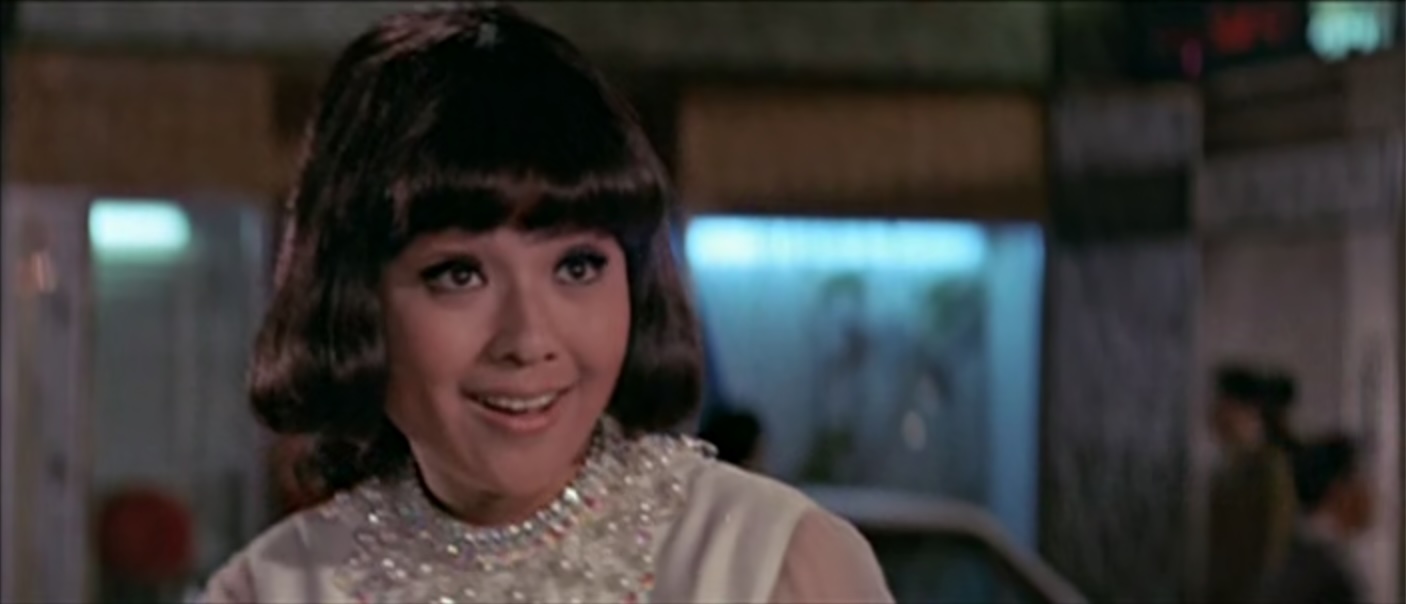
The Human Goddess
In the early 1970s there seems to have been a brief surge in ‘fox spirit’ movies. Li Han-hsiang may have kicked things off with A Tale of Ghost and Fox (which, sadly, seems to be entirely lost), and a few more followed (The Black Fox, Come Haunt with Me, etc.). I’m hedging my words here because fox spirit movies are a recurring genre in Hong Kong and Taiwan, so these movies may have just happened to come out around the same time.
The brief genre resurgence may have led to Shaw Brothers making The Human Goddess. While it is not a fox spirit movie, its tale of a heavenly maiden falling for a mortal man shares a lot of the same genre conventions. Take a fox spirit and make it slightly less horny and you have The Human Goddess, more or less.
Shaw Brothers already knew the story, having used the same source material for 1963’s A Maid from Heaven (which Ho Meng-Hua co-directed). Here, Ho Meng-Hua updates the tale, setting it in a modern-day Hong Kong full of striving grifters, horny women and even hornier men that our Heavenly Seventh Sister (Li Ching) naively drifts through.
Screenwriter was a rare job for Ho Meng-Hua and it would be the last time he received that credit. The result in The Human Goddess is kind of like someone wanted to spice up Mary Poppins with a lot of sexual assault. The number of people who get roofied in this movie is astounding. I counted 7, but I may have missed some. And no one seems to mind being roofied in the slightest. As a musical it makes sense for this movie to exist in a fantastical land without realistic consequences. But the roofies do push the limits of what I’m willing to accept.
Mixed in amongst the musical numbers and attempted sexual assaults is some light satirization of 1970s Hong Kong. The naive Seventh Sister continually sings about how perfect the mortal world with lyrics like “No authoritative regime. Peace everywhere.” and lauding everyone for having all of the food and money they need. That she’s singing this atop a run-down orphanage that is about to be torn down by a wealthy asshole and his scheming wife (mistress? it’s never clear) never seems to enter her mind. In a later musical number she teases all of the rich people for having glitzy exteriors but empty souls.
The satire never fully lands, partly because it’s all done in Mandarin while the people they are satirizing would be speaking Cantonese and partly because the people being teased never seem to notice. Which is also a satirical point, I guess.
Somewhere in there is Mang Hoi, who would have been 12 or 13 when this was made, making his second screen appearance. He likely plays one of the orphans, but I never spotted him. Frequently confused (even by me) for Yuen Biao, Mang Hoi was trained by the legendary actress and teacher Fan Guk-Fa (as were Lam Ching-Ying and Stephen Tung Wai, along with many others). Like many of her students Mang Hoi went on to mostly work as an action director where he delivered some total bangers: Ninja in the Dragon’s Den, Zu: The Warriors from the Magic Mountan, Yes, Madam! and Pedicab Driver to name just a few. Pick any movie where Mang Hoi handled the action and you’ll probably have a great time.
Ian Whitney
Published: 2026-11-08